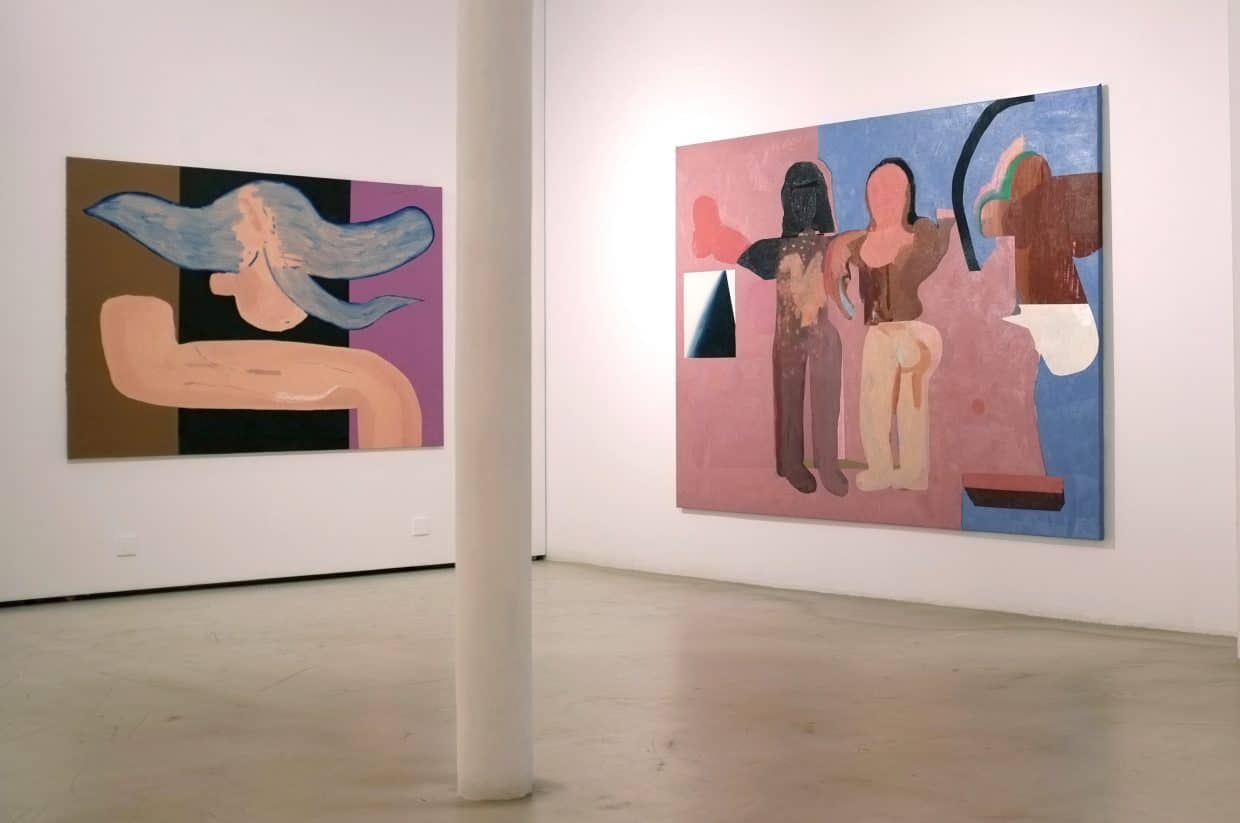
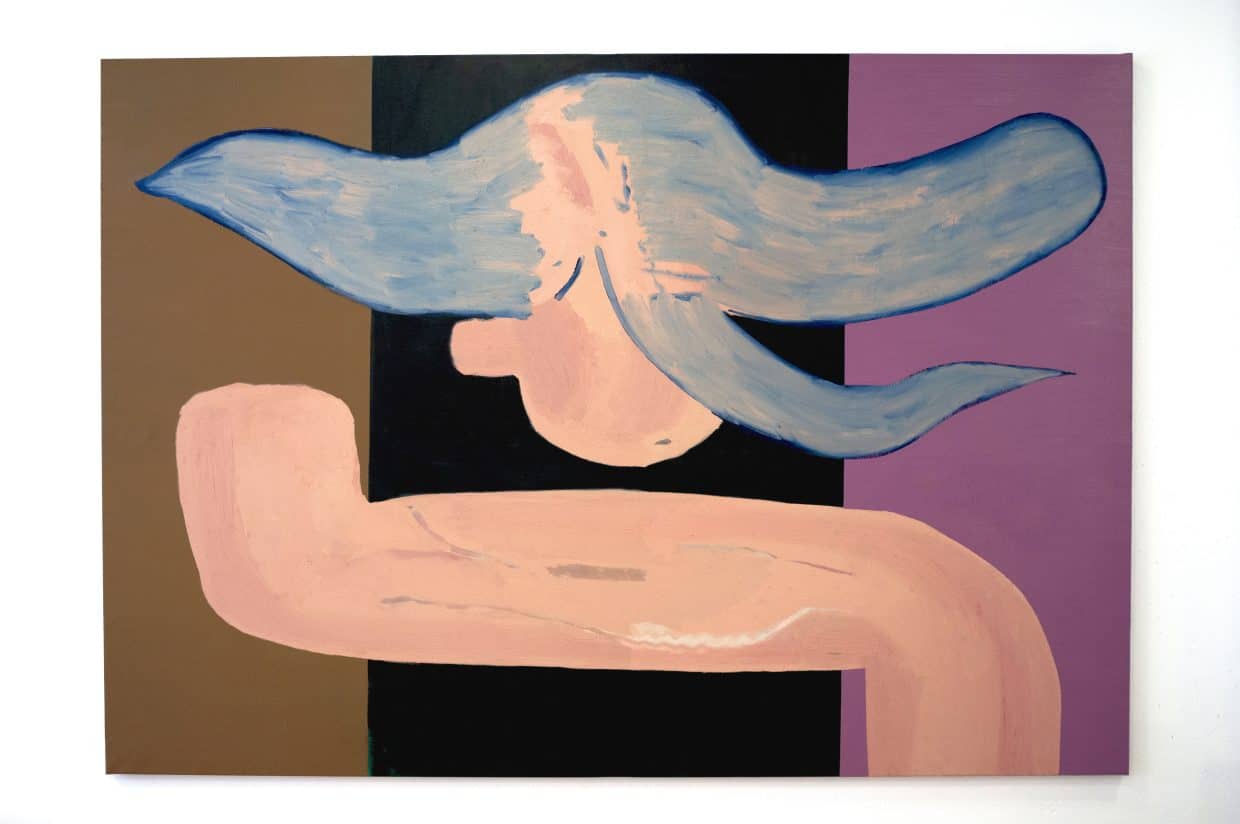
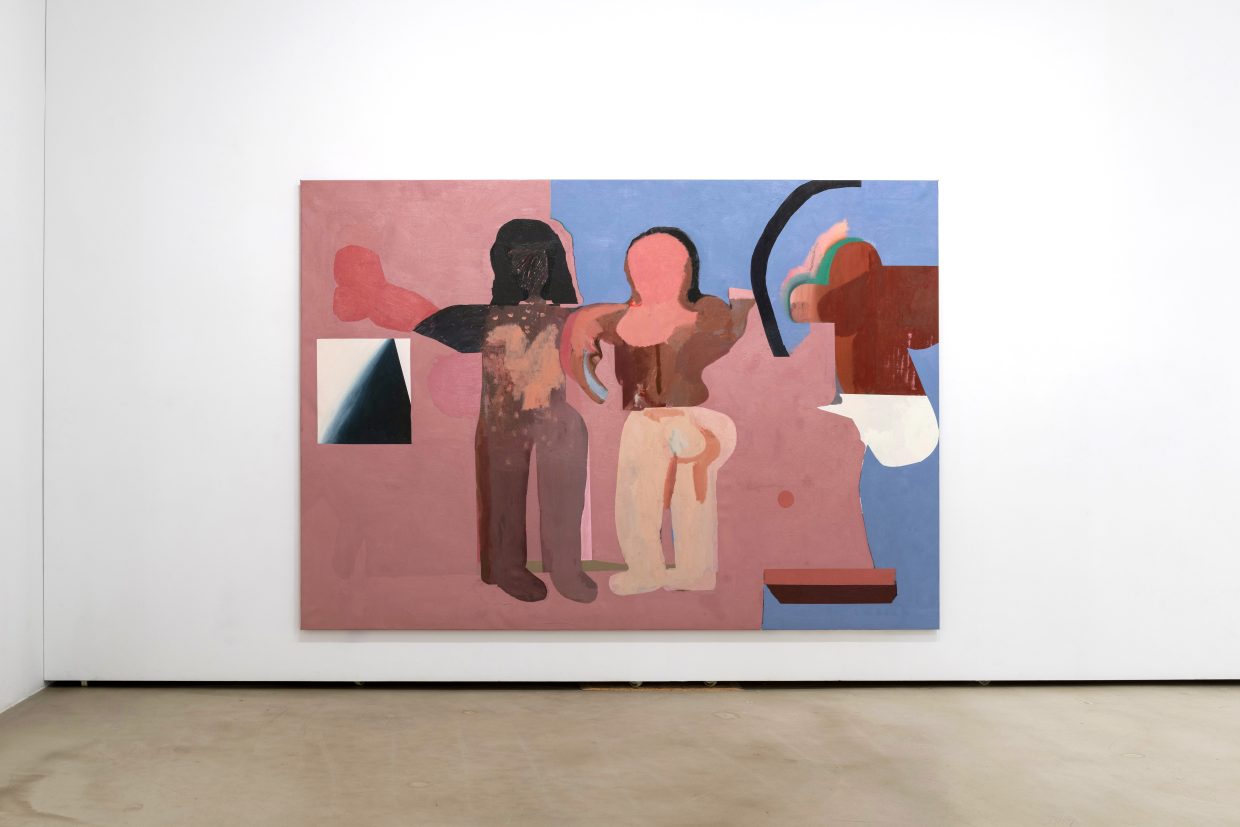
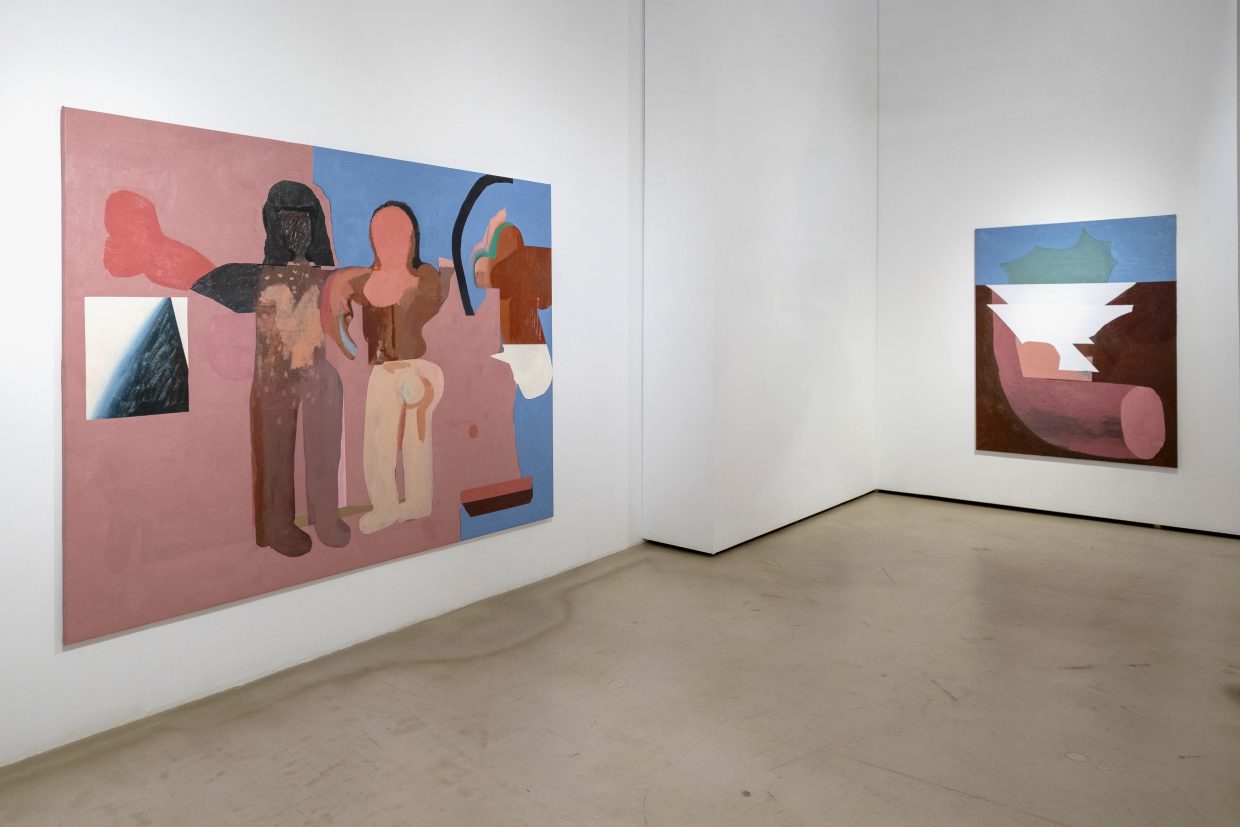
Damaris Pan Cuernos a la vista
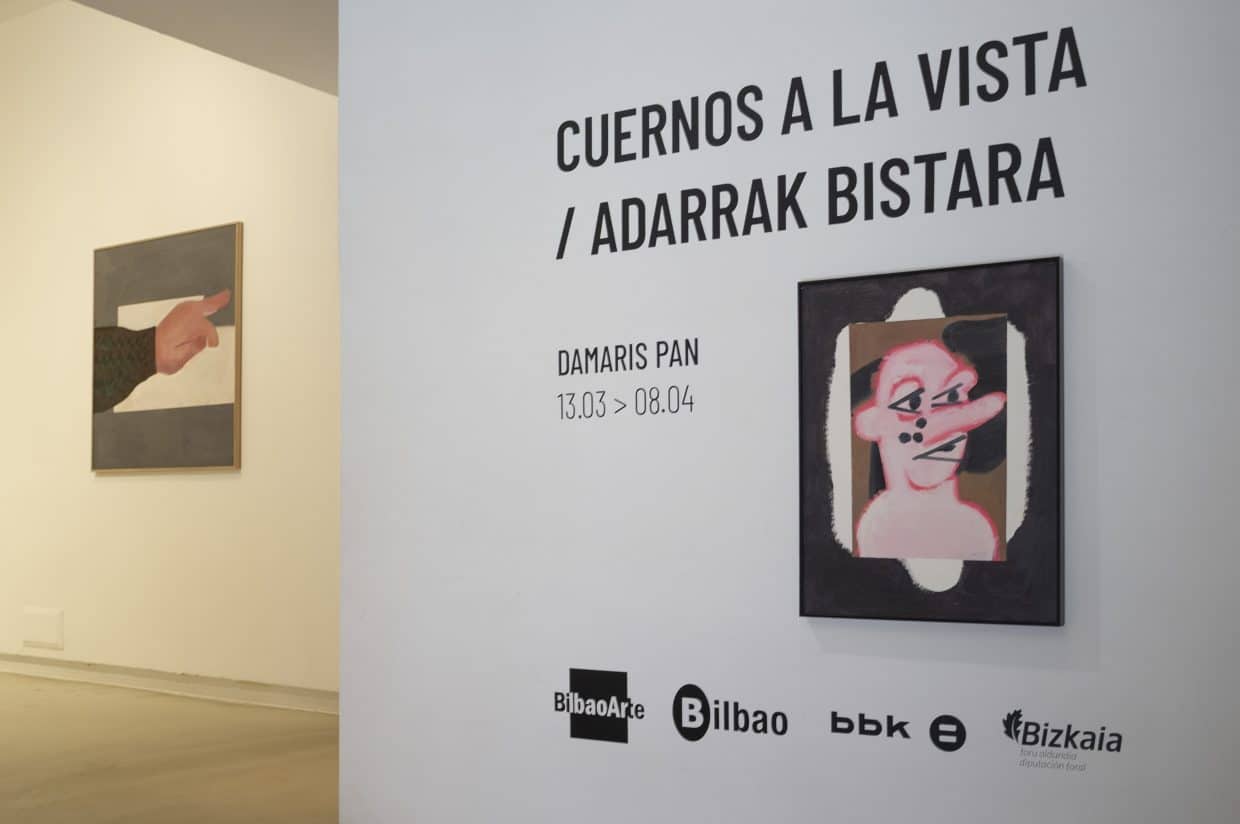
01 Jun - 19 Jun 2020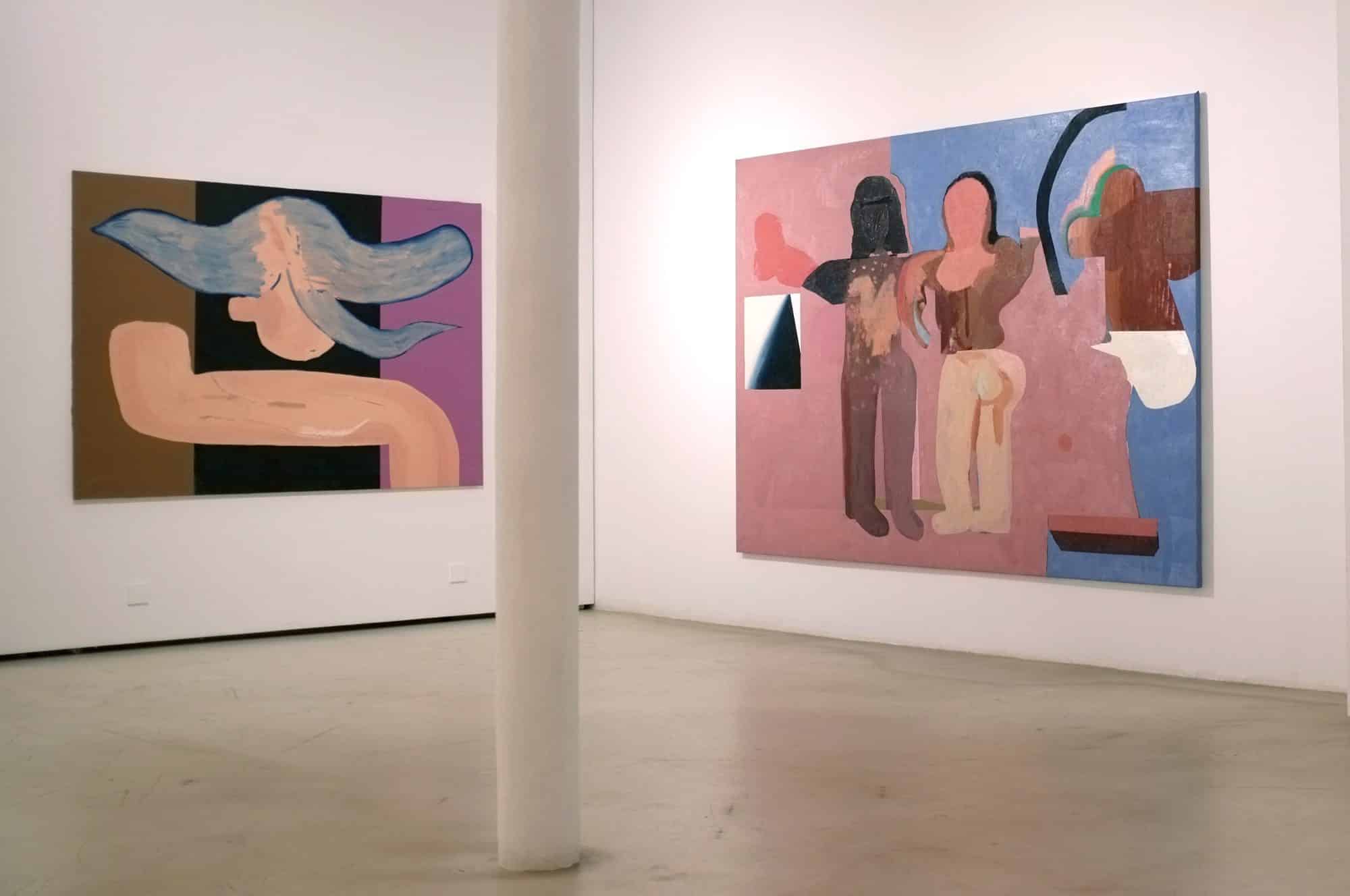
«Because I wanted to live bountifully and would betray my best friend in exchange for more life than one can have.» Clarice Lispector
The work for this exhibition came out of an ongoing process. In this, some things can be grouped a posteriori and a meaning suggested. A title can also help to shape the exhibition. Here, it attempts to synthesize a number of (somewhat present) ideas underlying the work and the paths of thought in the process of making it.
In order to test his new bride’s fidelity while he travelled to Flanders, the painter Pitas Payas painted a lamb next to her belly button. She betrayed him, and the lamb was rubbed off in the process. Before her husband’s return she asked her lover to paint it back on, whereupon he hurriedly painted a full-grown ram. When Pitas Payas asked the woman why the hell the lamb was now a ram, she replied that two years were long enough for it to have “grown horns” [1].
The Archpriest of Hita tells this story in «The Book of Good Love».
Cuckold on View was the newspaper heading for an article announcing a new episode of a reality show.
How does one betray the law of oneself, opposing the habit of self-preservation? To voluntarily betray the fiction of “I”. To betray what you believe is as a given truth. Collapsing the simulacrum. To seek to allow the apparently random occurrence to emerge more actively. How to betray Good Love?
Being faithful to the inability to be faithful. Faithful to the nothingness that emerges. Faithful to the endeavour to work with something akin to a doubt, which appears unrepeatably each time. Faithful to a meaning with no prior existence, to the occurrence itself rather than the circumstance that gave birth to it; having to reshape your inhabitance of the circumstance itself. There was once an excellent knight on horseback who mistrusted horses, wrote Paul Valery.
Being here requires betrayal as a means of being faithful to the occurrence, an immanent rupture from the process of creating. It also means you open yourself up to sensing new signs and relationships.
Paradoxically, being faithful would mean betraying the process of becoming – the being-as-desire – which cannot, in actual fact, be betrayed; as it always escapes.
But one cannot decide the Form of one’s betrayal, because there is no way to deny what you still cannot clearly see.
Cuernos a la vista, exposing your horns. A needle and hole in the cultural eye. How to continue seeing? Too look as you make, inside the process itself. To trust and mistrust, to lose your trust and regain it.
Creation as betrayal. Although the adult (fully grown) and adultery (corruption) seem to have a common origin, etymology distinguishes between them. Adultery as abnormal growth, leaving a material imprint.
The devil has horns. The devil as a state of exception at the core of every convention. Absence of taste, not bad taste. Evil, but not bad. The scream, but not horror. The devil as a personification against what is revered.
The still unknown. Nothing which is something. To float in nothingness. A continent without content. The literal thing. And nearly always, two poles, two eyes, body/air, centre/corner, heart/ribs, in tension, in agreement, in harmony and mystery. One form. Two horns.
In search of your own “skill”, outside the conceptual alibis; I think one asks oneself what it is to be a person and what it is to be an artist.
My own question is how to portray a conflict with Painting, in painting. Painting today, now, in conflict with Being and the being of things painted, and with Form, Colour, Space; in conflict with cultural norms and values, with the demands of being contemporary, and with Desire. Ever since the innocent gaze was lost, all we have had is the possibility of continuing to look and framing that conflict in order to, as María Zambrano put it, look to see. And to think what that innocent gaze might have been.
Cuernos a la vista, a voice crying land on the horizon, in the understanding that Beauty always arises anew before a new condition, in a rare intensity, appearing discontinuously, where she is not expected.
Damaris Pan
A letter from Adelina Moya
Barcelona, 20th February 2020
Dear Damaris: your email came as an unexpected gift, and compensated for other let-downs with work to which I’d dedicated more than just time and effort. I’m glad to know that my course on Art and Women – which seems so far away now – put you in touch with work by artists you didn’t know before. And I’m also happy to hear what you say about Isabel Baquedano’s exhibition.
It’s my turn now to get to know you as a painter, as an artist. And that is a new joy (here, far from the Basque Country), one which can’t be expressed in words but only felt inside. Let me first say that this text, after your unusual request, will be mediated by this mixture of emotions as well as the impossibility of getting to your studio and seeing the work itself. I can only base it on the images you’ve sent me, our long conversations, and your writings from 2019, which contain a few nuggets.
One of these is the story of your surname – it’s pure poetry, and communicates the meaning of your work, as a medium and manner of bringing together, or halting, time, life, in the metaphor of the fountain your need to paint flows from. Right now I feel like one of the birds who would perch on the fountain and drink from the millstone your granddad laid there – the stone from which the bird’s own ancestors had once pecked wheat berries at your great granddad’s mill. But I also feel as if I were stroking the rough stone which is nothing, only a vessel when the sun hits it… a story you slipped into the book «Pintura traza-costra. Hautsa eta izerdia» [2] where I think the way you came to painting is captured in a very physical manner. After all – to parody Simone de Beauvoir – one is not born, but becomes a painter.
After the first time we talked, I imagined your long, sometimes hard journey, following the well-aimed guidance of your sculpture class – though your inclination towards painting was clear. Your hard, but also enjoyable journey through Berlin, where you had long learning stays; America, and more recently China. With your peremptory need to learn, to make; painting layer upon layer, drawing, outlining the contours of painted matter as in a cut-out, recycling, revealing what you’ve learnt over time. And I like it when you say (more or less) that you put your soul into this thing, which is, in the end, just paint.
With a lot of insistence I finally got you to talk about a piece called Pepe. It opened up a new window to me; in it, I see your girlish eyes fill with amazement as you cross the threshold of Pepe’s home. Birds, lots of birds; figures like the one you painted; nuns, even guardias civiles, made by a man with no conventional art education – what I’d call a folk artist and others would call naïve. Pepe was my grandma’s brother, who came back from Switzerland before he retired, you say. And I continued to ask you questions, because this painting is different to the others; for instance, it’s a portrait of one of Pepe’s figures and we immediately identify the figure with its maker. What you remember of him. A figure that Pepe carved in many different sizes, with a heart chiselled into it that returns the wood to the tree it came from. It leads me to interpret your work as a recognition imbued with a certain amount of gentle humour.
Our conversations went on, down very different paths. Today, we speak of how certain body parts appear in your works – legs, mainly; and from there along different lines of thought to how the idea of boredom arises.
When whatever comes out won’t give you something different then you get bored and have to work at changing it until that finally happens. That was how you came up with your three-legged figure (animal, table legs, you say) – by getting bored of the two-legged one.
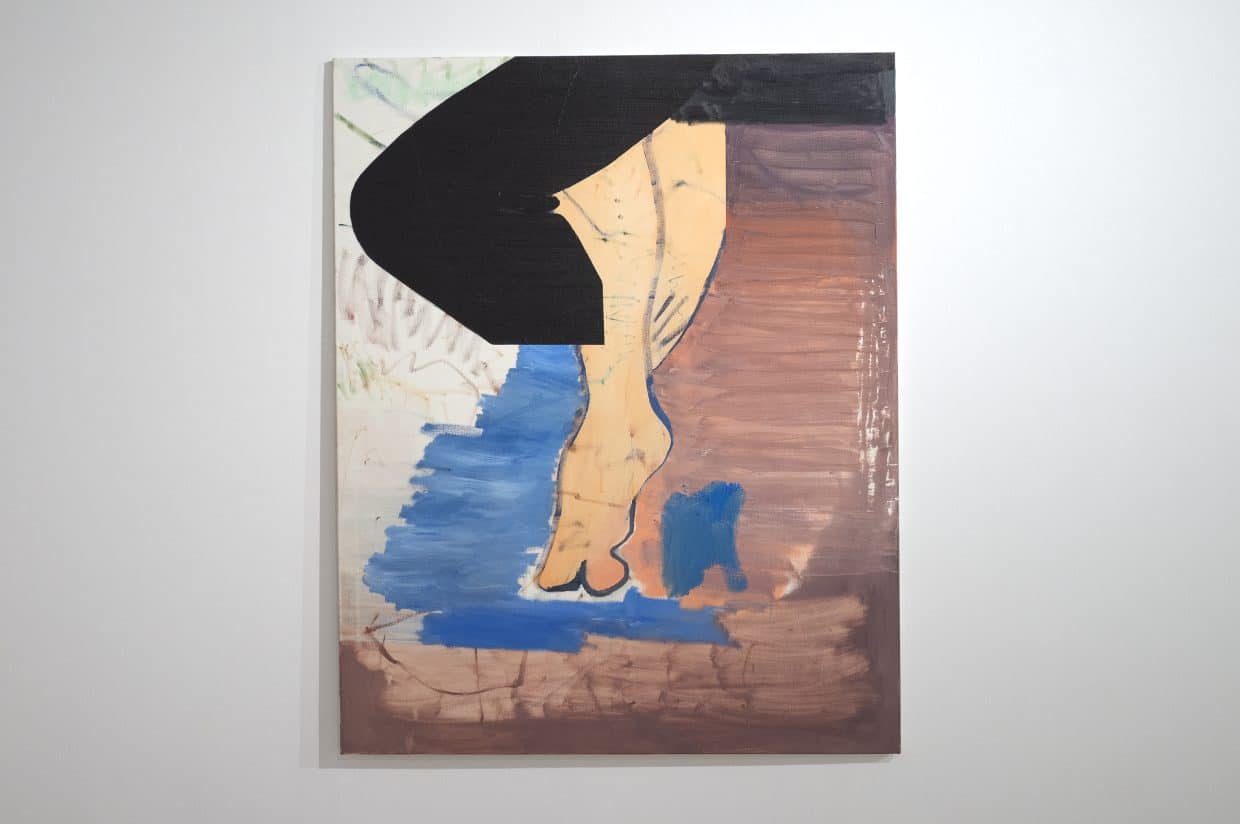
I imagine that, being a creator, you need each piece to surprise you with something new; something that will allow you to leap into a void. I see this in the diverseness of the images you make; in the exquisite, deeply worked, prominent colours, and sometimes in your determination to erase any extra matter, leaving just the traces of it so that we follow the line of the paintbrush, as if you were trying to lessen some of painting’s substance; or even not to paint. For instance, in one Untitled canvas a large part of the surface has been left bare, while the top is held by a black plane simulating the texture of a thick cloth. Underneath we see two legs and a naked foot outlined by the paintbrush.
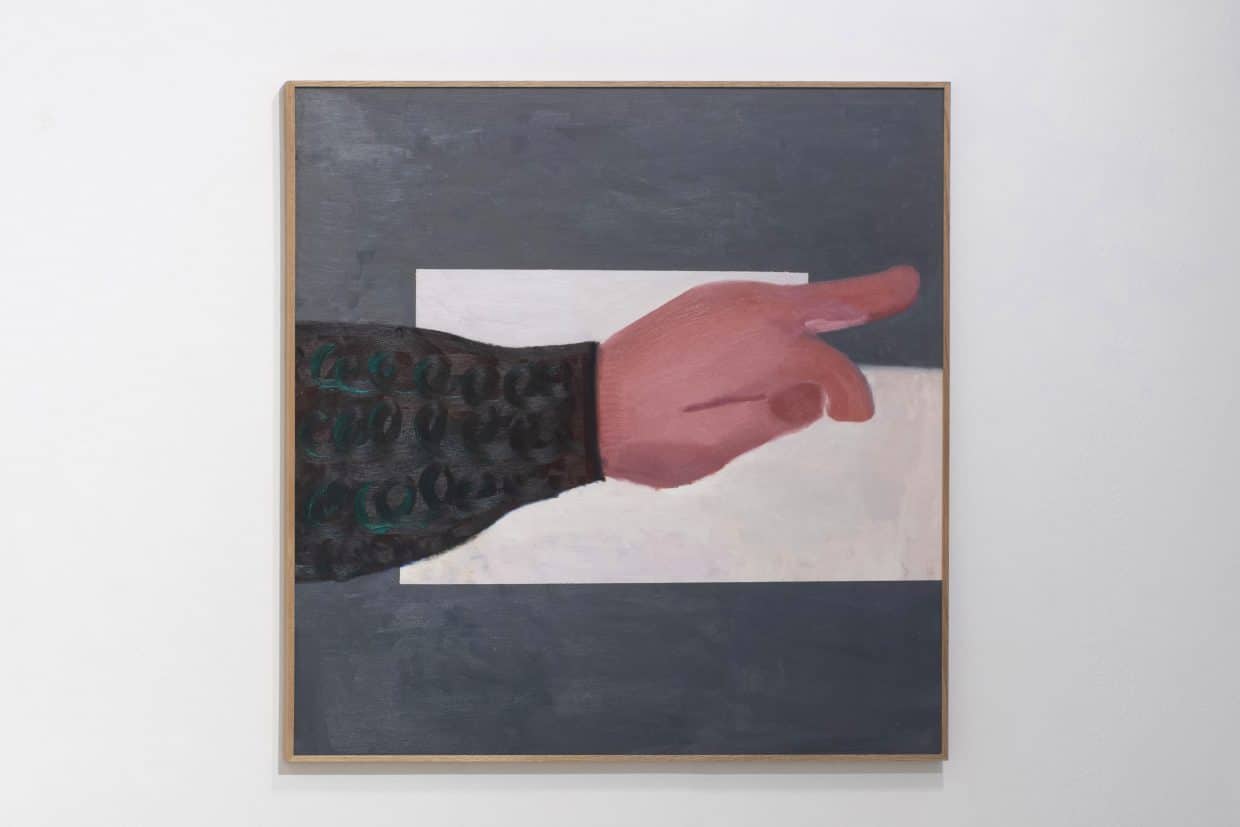
Today, too, another idea came up: the possibility of finding where you aren’t looking, of simply letting the motif go through its own metamorphosis in the understanding that the most important thing in painting is what is behind. What is unseen (and I quote John Berger from memory here). Otherwise, how could a finger become a leg? A leg wearing something like a blue sock, which the gaze is drawn to as strongly as to Andy Murray’s tennis legs (as a bad example).
As I approach the end of this text I still cannot find words for your version (appropriation, perhaps) of Las Señoritas de Avinyó. What astounded me most of all was the firmly outlined cartoonish character, the black dot of whose eye in which you fix the painting’s relationship
to the original work. Beyond the bright blue of the background and the different flesh-like tones of the faceted figure displayed in geometrical planes, my attention was drawn by the dark grey, almost black colour’s resonance with the Picasso original. You had said that this work had actually been conceived previously, in Mrs. & Mr. a heavily-worked piece, in which, as you applied blue paint over the centre of it, brought to mind Picasso’s painting which so stunned you at the MOMA. But I never would have noticed this.
I also don’t quite understand how it is that I’m so captivated by what I call your still lifes. None of them have a title so I can easily refer to them by date: in the «oldest» one (2016) I find it interesting how drawing takes precedence, and how the two areas relate – painting above, drawing below –, coming together in an intermediate zone. You have given the matter of painting as much importance as the bare, radiant white paper ground.
There are three clearly differentiated parts to this work, whereas in the still life of the jar (2017) (pág.74), which can also be interpreted as a female figure, the image is condensed in the middle of the painting, like in some of Amelia Pelaez’s flower paintings. But you tell me that your real interest was in Paula Modersohn-Becker, the museum to whom you went to see in Bremen. She was another painter strongly drawn by the rustic or the naïve.
This work is dominated by curves and the amount of matter in it, as well as the role of the colour black between pink and a yellowish green on a blue background.
The third work I’d like to mention is the one you called Peanut and acorn. There I see the sole of a shoe and some kind of alluring blue and purple object. Both of us agree that the absurd humour in the piece, as in other of your works, is reminiscent of Philip Guston. Guston
was magnificent in his obvious integration of the comic aesthetic; but you use humour more subtly, less explicitly, like when you decide to paint your shadows in yellow.
I could go on – there are many more works I like – and talk about the (possible) vulgarity of your exhibition title (Cuckold on View, I mean). And the painting you say you like because of its ugliness, the one you call two sausages. But time is running out, and my energy is also a little scarce. So I will say goodbye here, my dear friend and student from years ago.
Adelina Moya
[1] Translator’s note: Cuernos a la vista, the title of the exhibition, would be literally translated as “Horns on View”, as in the Spanish expression for the cuckold, who “has horns put on him”.
[2] Swimming Pool. Artistic practice-based research. University of the Basque Coutry. laSIA Research Group, 2019.