Joaquim Chancho Al llindar de la geometria
16 Dec 2010 - 27 Mar 2011
JOAQUIM CHANCHO: THAT UNEXPECTED CANVAS
“The artist is perhaps the most highly evolved of all types, prehistoric man nonetheless continues to persist in him. The world is fresh and new to him, it’s examined and enjoyed through more sharpened senses than those of civilized man; he has kept the magical feeling of the unknown, especially the poetics and the technique of his hands”.
Henri Focillon
During more than a hundred years since the beginning of modernity to the first avant-garde movements we have witnessed a progressive spread of the domains of the artistic, regarding both its contents and its ways of expression. Exempted modern artists from their obligation to represent the world, their works have started to become more and more speculative, looking for the original and the innovative that turn 20th century art into a repertoire of options whose most of its discoveries ended up being ephemeral and transitory. In this secular process, the line that starts with the development of painting and sculpture extends to the happening and the performance, to the non-manipulated industrial object and to new technologies.
As a consequence of this transformation, the current concept of “art” and “the artistic” profoundly differs from what was presented as such at art galleries less than a century ago. Once the “dematerialization of the work of art”(1) has been accomplished, attitude, action and even the project not necessarily realized are part of the contemporary art field. And the same happens with the consideration about the condition of artist, which does not only refer to people trained in techniques and formal knowledge but also to experts of other disciplines. In fact, although artists keep the authorship of the work, nowadays many plastic and visual creators commission the material execution of their works to other professionals. Some of them have many assistants in their studios at their disposal. In short, to many visual artists –especially those artists working with industrial materials, as well as creators of electronic, digital or net art – the material execution or the mastery of technical resources has ended up being a secondary matter.
The works that illustrate the starting point of Joaquim Chancho’s show “Al filo de la geometría” coincide with the highest expansion of the boundaries of art and they run parallel to the emergence of the new artistic practices mentioned before. As we will see, Joaquim Chancho laid down the bases for his art while art was being fragmented, spreading out and adopting new forms in texts, documents, recordings, photocopies, walks or objects. When artists decided to abandon their studios and the happening and performance get on the streets. In those years that put an end to the period of introspection in which the end of the Second World War devastated Europe and the Giaconda “was taken to the metro” by some French students. In the mean time, new forms of intellectualized art were forged –such as the Conceptual or the Minimal– or the banal –such as Pop Art–. While all these things were happening and art opened up to new paths, an artist trained in Fine Arts, a man of canvas and pigments, a professor, started his personal journey through painting.
The thing is that Chancho’s work can be observed from different perspectives. From a more spiritual and aesthetic view that is inferred from the predominance of black or the use of monochrome palette –from that formal and conceptual emptying of the canvas that links to the mystic visual and poetical tradition– his painting is part of the informal existentialist tradition, of that art with consciousness that goes through the European post-war period. From a more vitalistic and exuberant perspective –the one praising nature and celebrating life– his work slides towards pure visual expressiveness, the exaltation of painting as space for the existence of the human.
Time, space, light, shape, color… all these aspects and concepts that pictorial abstraction take us to after more than a hundred years of experimentation are to be found, with unusual balance, in Joaquim Chancho’s work. Works like his are the ones which instruct us to see the world, to materialize concepts and ideas, to go beyond the boundaries of words and objects.
Natural ally of philosophy, it is by means of abstract painting that great thinkers such as Kant, Hegel, Heidegger, Wittgenstein or our Ortega, have shown the possibility to think in images all those evasive concepts that escape our comprehension. And abstract is precisely this, the thing whose existence doesn’t lie on the visible.
Who could it be but Jackson Pollock with his well-known drippings who succeeded in formatting mankind’s collective memory by means of the best explosion and atom’s journey? And wasn’t it another abstract artist, Mark Rothko, who provided us with the most intense visual sensation of that transcendental experience that we call spirituality? Weren’t Wols or Mathieu’s gestures the best metaphor for the outcry of such a dark period?
Even nowadays, when we need the assistance of images to help us think about the new challenges proposed by science, or when we are simply in need of finding visual areas for escaping or reflecting in order to get attached to our intuition and consciousness, a non-figurative composition breaks into the scene to provide us with that mental or spiritual nourishment that cannot be found in the myriad of “real” images that are part of our information and knowledge setting.
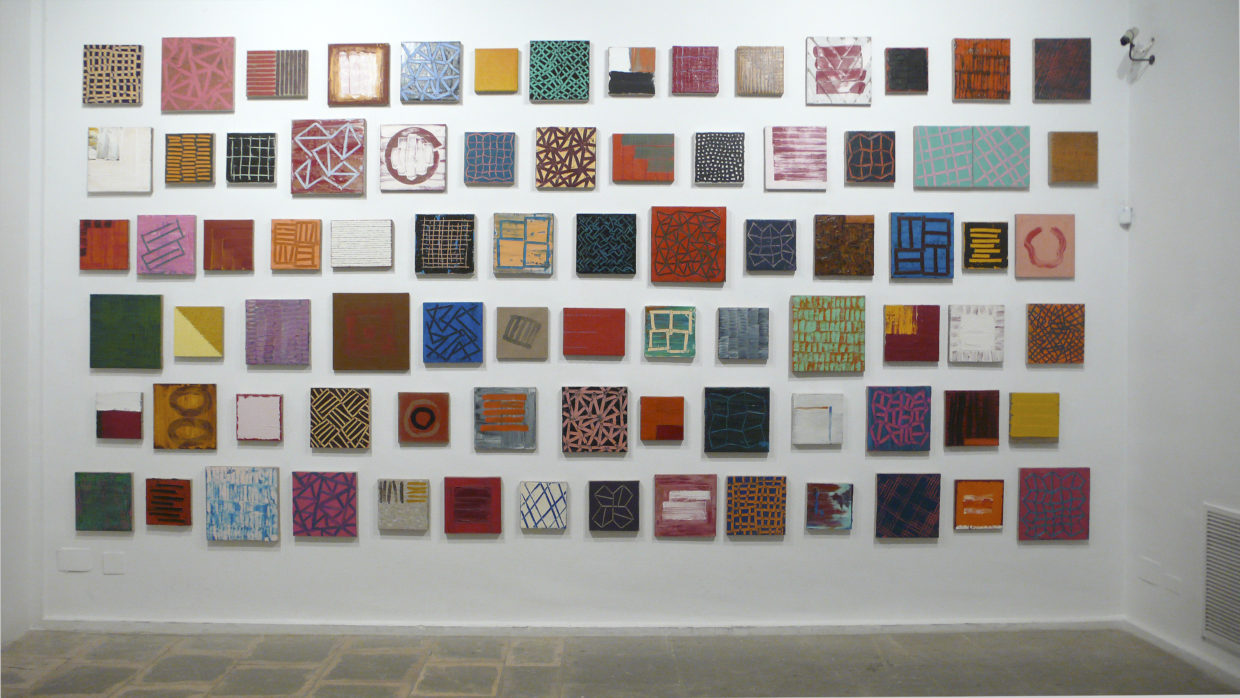
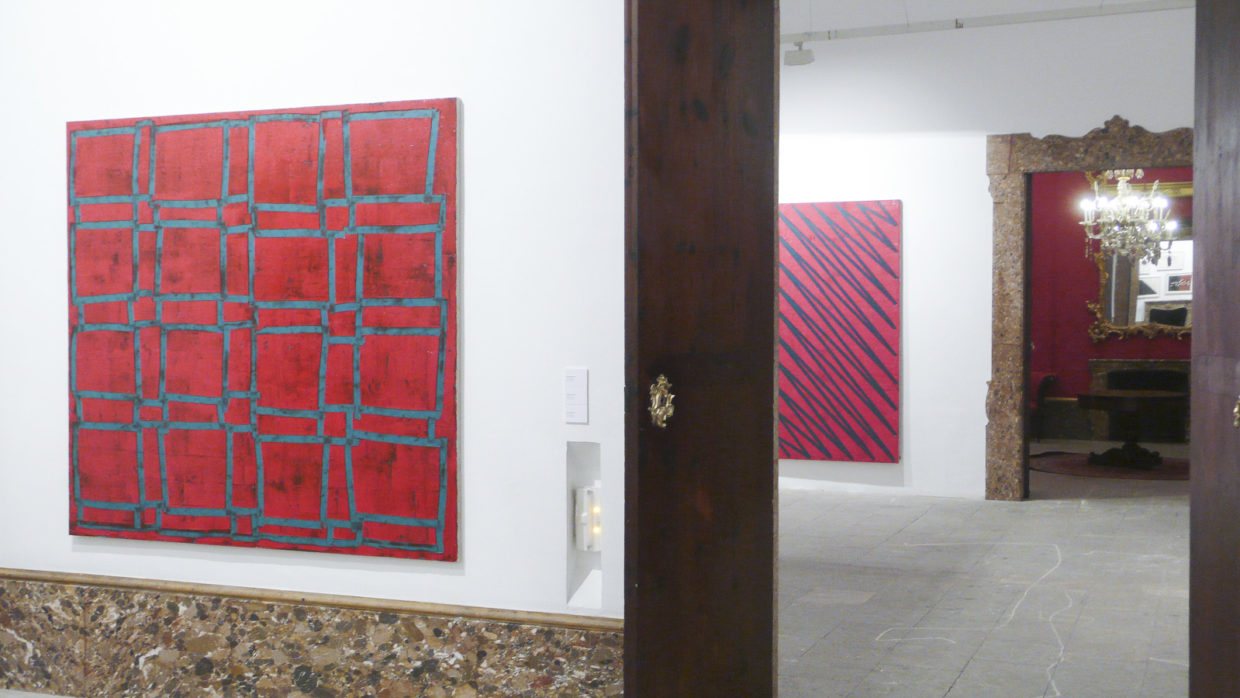
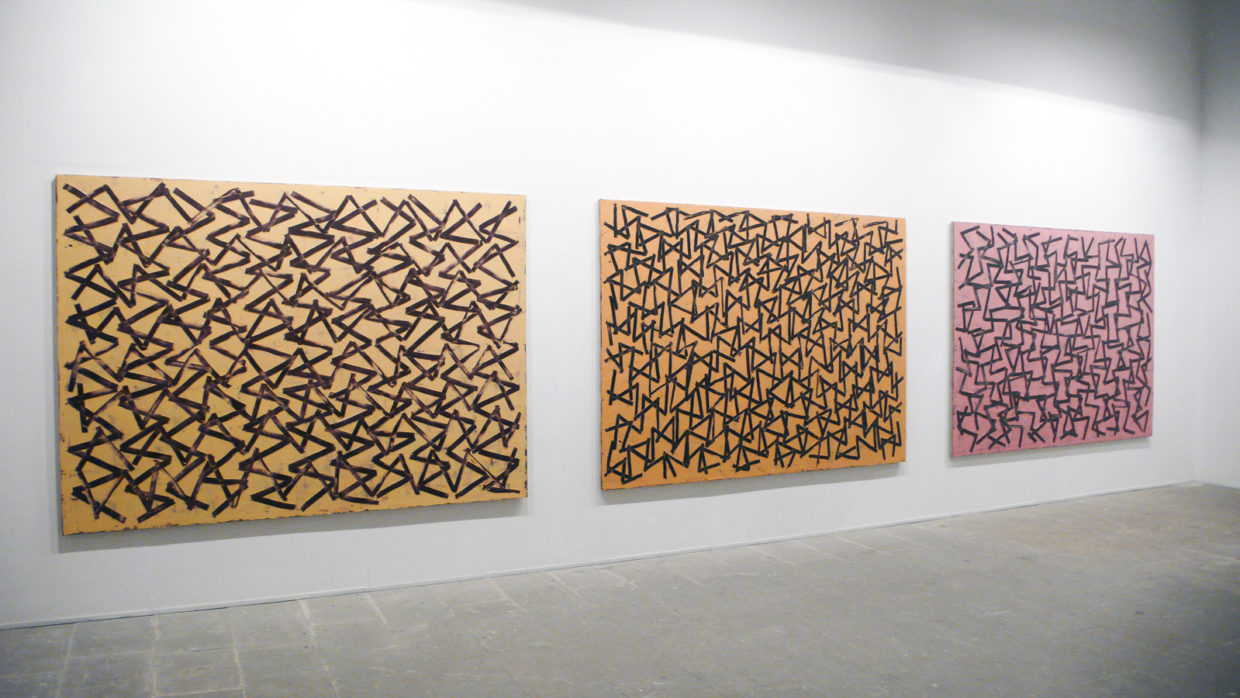
And it is about this choice and this journey, which lasts more than forty years, what we would like to reflect on with this exhibition that focuses on specific moments of his career: those moments in which geometry articulates the artist’s discourse. A discourse in which aspects such as the symbolic or naturalist use of color or the shaking gesture of his hand that covers once and again the canvas, prove to be essential. Thin lines, thick strokes, grids, nets, tangles, calligraphies, quadrangular shapes, polygons… the collection of geometric shapes that has allowed Joaquim Chancho to work on the canvas precisely with the freshness that Focillon talks about in the quotation opening this introduction. It is as broad as stimulating and it provides his painting with both homogeneity and diversity.
Once and again,critics have interpreted the artist’s extensive production from the coherence of a way of experimentation and discovery that sets its centre of gravity on a human approach to geometry and that reaches its climax around the middle of the first decade of the 21st century, when Chancho carries out some of his most personal and groundbreaking works.
Essential resource of pictorial reflection for many generations of artists, geometry as synonym of reason has often been compared to the spontaneous emotive nature of the gesture. From Kandinsky and Malevich onwards, abstraction has tended to be considered from this double condition or opposition. And, however, as we will try to explain on these pages, there are examples of artists who make gesture and geometry into just one resource for their works: another type of geometry that is able to question space with rigor as well as with sensuality and emotion. This is the case of Joaquim Chancho, an artist who fills his works with this emotion – “magic of the unknown”, a painter who makes us see painting as if each picture was a new horizon, a new threshold.
1. See: Lucy R. Lippard: Six Years. The dematerialization of the art object from 1962 to 1972.